Posts

Baroque

Image
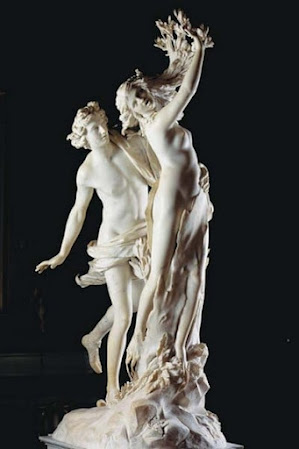
  Apollo and Daphne   Gian Lorenzo Bernini (1622–24; Galleria Borghese, Rome)      Apollo and Daphne is a sculpture by Gian Lorenzo Bernini. It was commissioned by Cardinal Scipione Borghese at the beginning of Bernini's career. The statue depicts Phoebus (Apollo), pursuing Daphne, the daughter of Peneus, who denied the love of men. This statue is captivating, the flowing movement of their bodies, the curves and features of their lithe movements, the details of their bodies and their curves adding to the passion of the pursuit. It makes me feel like I glimpsed a moment in ancient history of the gods. I wish the statue had color to it, but the solid white makes it seem like a ghost of a memory of times past. The energy, movement, the flowing diagonal movements of their bodies, the intensity and the feeling that you're glimpsing a moment in time are all indicators of the Baroque art style. (Harris and Zucker)        Bernini was greatly...
Image
  ANDREA MANTEGNA (1431-1506) 'The Triumph of the Virtues - Minerva Expelling the Vices from the Garden of Virtue', 1502 Fit for a King: Slave To Nothing album cover  October 14, 2014  Solid State Record Label The top artwork is by Andrea Mantegna, an Italian Renaissance painter who was a proponent of humanism. His work showed detailed humans and a 3D feel to the work. (Foundation) I smiled as soon as I saw this work because it had the same energy as a metalcore band's album cover that I listened to. The second piece of art, the album cover for Fit For a King, shows a being breaking its chains from its vices. Their whole album is about killing what kills you, freeing yourself from vices. I get the same feeling from Triumph of the Virtues, the battle to overcome vices and the things corrupting us. Every time I look at the artwork, I see greater details, colors, and more of the story. I am amazed by the clouds, sky, background elements of the hills, and what appear to ...

Art Analysis

Image
  Pit 1, Army of the First Emperor, Qin dynasty, Lintong, China, c. 210 B.C.E., painted terracotta  (photo:  mararie , CC BY-SA 2.0) Army of the First Emperor of Qin in pits next to his burial mound, Lintong, China, Qin dynasty, c. 210 B.C.E., painted terracotta (photo:  scottgunn , CC BY-NC 2.0) Army of the First Emperor Qin Dynasty, Lintong, China (210 BCE)   The first emperor of China was Qin Shi Huangdi. He championed the tomb construction, which took 38 years, and a reported 700,000 convicts to labor for the last 13 years. It was then covered in dirt, grass, and trees disguised as a hill until it was found in 1974. (Mittman, 2019) These sculptures transport the viewer back in time. The phalanx of warriors and chariots elicit emotions of awe and respect. It breathes life into history; the orderly balance of the army shows discipline and order. The serried rows of warriors show unity; the lack of color makes the army even grander. Instead of a busy scene with...

Schaeffer Jordan Art

Image
 Hello World, My name is Jordan Schaeffer, or as most call me, Jordy. I am pursuing a bachelor's degree in business and applied management, now a senior. I am originally from Kansas City, Missouri, and moved to Alaska five years ago. I have two dogs: a German Shepherd named Chilli Bean and a Terrier named Remy. I love reading books; I own nearly 500 and read daily. Fantasy and sci-fi are my favorite genres, but I also read psychology and books about the brain. I also enjoy hunting, fishing, camping, and hiking. I plan to go to Clemson, South Carolina, once I graduate for a graduate degree in biomedical engineering. The Fortress of Königstein  by Bernardo Bellotto (1756-1758) Art is interesting. I enjoy attending the Nelson Atkins Art Museum in Kansas City, Missouri. So much of the art impresses me, but there is a lot of the art that I don't understand. It looks like a child produced the art, or it's some sort of joke because there are a few squiggles on the paper. I own som...